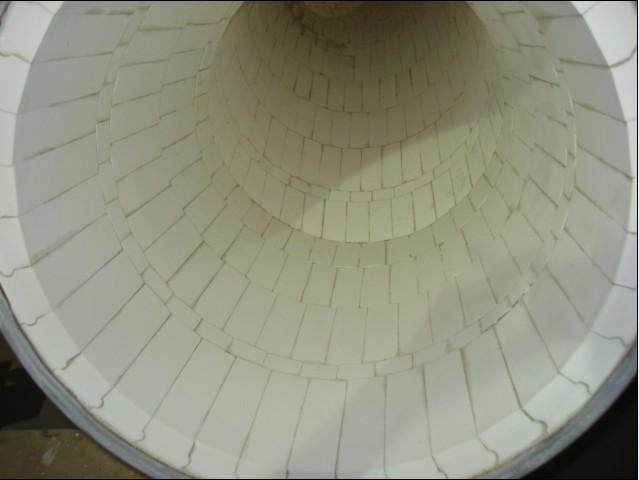
Wear‑Resistant Ceramic Lined Pipe
Wear‑Resistant Ceramic Lined Pipe
- 产品详情
- 产品参数
[Technical Background]
In high-wear scenarios such as cement, mining, thermal power, metallurgy, and chemical industries, conveying pipelines are chronically subjected to severe scouring by sharp media including ore sands, pulverized coal, and slag. Even with thickened steel plates or hardfacing overlays, conventional metal pipes still suffer from wear-induced perforation, frequent replacement, and shutdown maintenance—leakage risks, efficiency degradation, and surging maintenance costs become the "hidden cost killers" that constrain production.
[Titan-Shield Solution]
Alumina Ceramics + Professional Construction – Building an Ultra-Wear-Resistant Piping System
[Titan-Shield Wear-Resistant Ceramic Pipeline Construction Service]
Based on 95% alumina ceramics as the core material, combined with modular on-site construction techniques, it equips industrial pipelines with a "ceramic armor" to achieve 10 times the wear-resistant service life, zero leakage risk, and minimal maintenance, helping enterprises reduce costs, improve efficiency, and secure a winning future.
[Core Advantages]
Dual Innovation in Material + Process – Redefining Wear Resistance Standards
1. Alumina Ceramic Performance Parameters: Hard Data That Proves Capability
| Parameter | Performance Indicator | Industry Comparison |
|---|---|---|
| Al₂O₃ Content | ≥95% | Far exceeds ordinary ceramics (80%-90%) |
| Rockwell Hardness | HRA 85-90 | More than 3 times higher than high-chromium steel |
| Density | 3.6-3.9 g/cm³ | Lightweight design reduces pipeline load |
| Compressive Strength | ≥850 MPa | Excellent impact resistance |
| Wear Resistance | 0.1g (ASTM G65 standard test) | 20 times that of manganese steel, 50 times that of rubber |
| Temperature Resistance | -50°C ~ 600°C | Excellent thermal shock resistance, no cracking risk |
| Corrosion Resistance | Resists acids and alkalis (pH 3-11) | Adapts to desulfurization, chemical and other corrosive environments |
2. Modular On-Site Construction Process: Efficient, Precise, with 50% Shorter Lead Time
Step 1: Substrate Pretreatment
Grinding or sandblasting technology is employed to thoroughly remove rust, oil, and contaminants from the inner pipe wall, achieving a surface roughness of Sa 2.5 to ensure strong bonding between ceramics and the substrate.
Step 2: Custom Ceramic Tile Fabrication and Installation
Precise mapping: 3D laser scanning of pipe dimensions for custom-curved ceramic tiles (specifications: 10×10×3mm to 50×50×10mm) to match complex structures such as elbows and reducers.
High-strength bonding: Modified epoxy resin adhesive (temperature resistant up to 200°C) is applied with dedicated fixtures to achieve seamless ceramic tile assembly with misalignment < 0.5mm.
Step 3: Curing and Reinforcement
Stepwise curing: 24 hours at room temperature + 4 hours heat treatment at 80°C, achieving bond strength ≥15 MPa.
Surface sealing: Nano-scale silane penetrating agent is sprayed to fill ceramic micropores, preventing permeation and corrosion.
Step 4: Quality Inspection and Acceptance
Non-destructive testing: Endoscopic inspection verifies ceramic coverage; ultrasonic testing checks adhesive layer uniformity.
Simulation testing: Ball-passing tests ensure a smooth and obstruction-free inner pipe wall; wind tunnel tests verify aerodynamic performance.
[Application Scenarios]
Mining industry: Tailings conveying pipes, cyclone feed pipes – resisting quartz sand and iron ore impact.
Thermal power industry: Pulverized coal conveying pipes, ash removal pipes – resisting fly ash wear with 8 times longer service life.
Metallurgical industry: Blast furnace coal injection pipes, sintering dust collection pipes – resisting high-temperature oxidation and particle erosion.
Chemical industry: Acid/alkali medium conveying pipes, slurry circulation pipes – preventing corrosion and scaling.