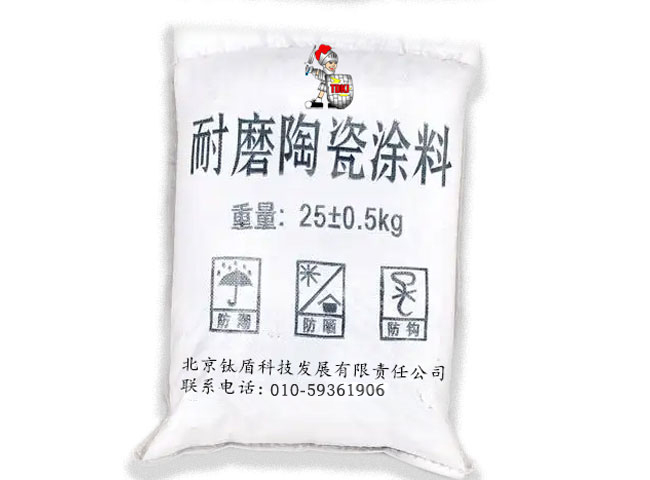
Wear-Resistant Ceramic Coating
Wear-Resistant Ceramic Coating
- 产品详情
- 产品参数
[Product Introduction]
Wear-resistant ceramic coating is an inorganic non-metallic cementitious material. Through special processing of the raw materials, it achieves extremely high strength, reaching ceramic-level bonding strength. Generally, strength and wear resistance are directly proportional, hence the name "wear-resistant ceramic coating." The wear-resistant ceramic coating mainly consists of two phases: wear-resistant aggregates and ultra-fine powders. The particles are densely packed, resulting in no significant macroscopic defects and high bulk density. Its strength reaches or exceeds 160MPa, which is incomparable to ordinary concrete and refractory castables. The raw materials used in wear-resistant ceramic coatings are primarily ionic compounds and partially synthetic covalent compounds. According to solid-state structure theory, ionic and covalent bonds are strong bonding forces, resulting in high strength and rigidity that effectively resist impact forces and shear stresses from particulate materials. The bonding system between materials employs composite reinforcement measures and special treatments to form chemical bonding, resulting in very high strength.
[Product Advantages]
1. Extremely high mechanical strength and rigidity
The wear-resistant ceramic coating mainly consists of wear-resistant aggregates and a binder system, exhibiting ceramic-like properties with compressive strength up to 120MPa and flexural strength up to 15MPa.
2. High temperature resistance
The maximum service temperature exceeds 1000°C. At high temperatures, it forms a mullite phase solid solution, which further enhances strength. Its wear resistance is unmatched by any current wear-resistant product.
3. Good corrosion resistance
Due to the special chemical composition of the raw materials, it exhibits excellent corrosion resistance.
4. Excellent integrity
The wear-resistant ceramic coating employs dual or even multiple reinforcement measures, effectively improving material properties. Additionally, the low thermal expansion coefficient of the ceramic material ensures volume stability without cracking, thus providing excellent integrity. Furthermore, the construction is applied as an integral layer without joints, further enhancing overall integrity.
5. Excellent toughness and vibration resistance
The wear-resistant ceramic material uses dual reinforcement measures of randomly oriented steel fibers and directional mesh reinforcement, further improving toughness through coupling effects, resulting in high fracture toughness that effectively prevents damage and spalling caused by impact forces. On the other hand, due to the strong bonding of ionic and covalent bonds with high bond energy, low temperatures have minimal effect on it. Moreover, its vibration energy frequency is extremely high, making it difficult for ordinary temperature changes to pose a threat, thus preventing material damage from thermal shock.
6. Good environmental compatibility
The use of acid-resistant and alkali-resistant synthetic neutral raw materials prevents reaction with slag. At the same time, as these materials are mostly high-temperature synthetic raw materials with well-developed crystals and complete structures, ambient temperature has little effect on them. They are environmentally inert materials with low environmental sensitivity.
7. No environmental pollution
The wear-resistant ceramic material is an inorganic non-metallic material, primarily composed of silicates, with a composition similar to soil. It does not cause soil degradation or affect the ecological environment.
[Technical Parameters]
| Parameter | Value |
|---|---|
| Al₂O₃ (%) | ≥35–75 |
| SiO₂ (%) | ≥20–40 |
| Maximum Service Temperature (°C) | 600 |
| Bulk Density (g/cm³) | 2.2–2.8 |
| Compressive Strength (MPa) – 110°C × 24h | ≥75 |
| Compressive Strength (MPa) – 550°C × 3h | ≥55 |
| Flexural Strength (MPa) – 110°C × 24h | ≥7.5–9 |
| Flexural Strength (MPa) – 550°C × 3h | ≥4.5 |
| Linear Change Rate (%) – 550°C × 3h | ±0.1 |
| Application Method | Tamping or Troweling |
[Service Life]
The service life of the wear-resistant ceramic layer is dependent on the particle size, concentration, velocity, and impingement angle of the dust particles. The smaller the particles, the lower the concentration, the lower the velocity, and the smaller the impingement angle, the longer the service life of the wear-resistant ceramic layer.