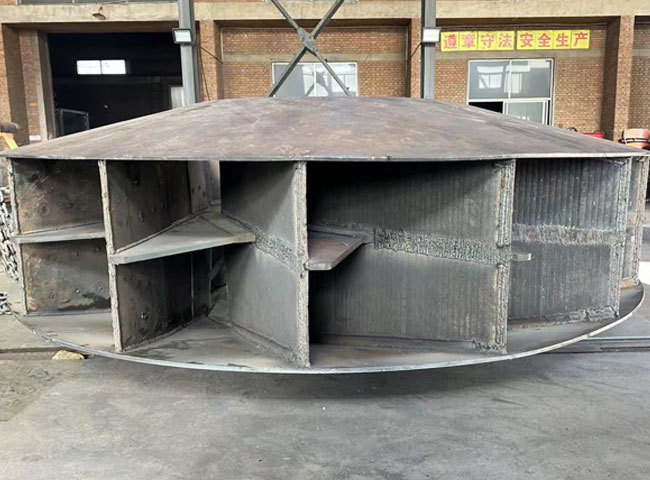
Cemented Carbide Wear-Resistant Impeller
Cemented Carbide Wear-Resistant Impeller
- 产品详情
- 产品参数
[Industry Pain Points]
Wear – The Hidden Killer of Efficiency and Cost
In high-wear industrial scenarios such as mining, metallurgy, power generation, and cement, fan impellers are chronically subjected to severe scouring by sharp particles including sand, slag, and pulverized coal. Even with high-chromium steel or hardfacing overlays, conventional impellers still suffer from rapid wear, short service life, and frequent maintenance – surface pitting, aerodynamic imbalance, and sharp efficiency decline, consuming millions in repair costs and production losses annually.
[Titan-Shield Solution]
Cemented Carbide Composite Coating – Ushering in the "Ultra-Wear-Resistant Era"
The Titan-Shield Cemented Carbide Wear-Resistant Composite Coated Impeller, based on nano-scale cemented carbide coating technology, integrates metallic toughness with ceramic hardness to build a three-dimensional protection system against wear, impact, and corrosion, fundamentally conquering the persistent problem of impeller wear.
[Technical Advantages]
1. Super-Hard Armor: Nano-Scale Cemented Carbide Composite Coating
Material innovation: Tungsten carbide (WC)-based cemented carbide with cobalt (Co) and nickel (Ni) metallic binder phases is applied via High-Velocity Oxygen Fuel (HVOF) spraying to form a dense nanocrystalline coating, achieving surface hardness of HRC 60 or above, with wear resistance 8-10 times higher than high-chromium steel.
Gradient composite structure: A metal-ceramic gradient transition layer is designed between the coating and the metal substrate, achieving progressively increasing hardness from inner to outer layers – preventing coating delamination while buffering external impact forces, with particle erosion resistance improved by 300%.
2. Precision Coating Process: Controllable Thickness, Adaptable to Complex Curved Surfaces
Uniform coverage: Robotic automated spraying precisely controls coating thickness (0.3-5.0mm), perfectly conforming to impeller curved surfaces, edges, and other vulnerable areas with dead-angle-free protection.
Superior bonding strength: Coating-to-substrate bond strength exceeding 80MPa, far surpassing industry standards (≥50MPa), ensuring no peeling or cracking during long-term high-speed operation.
3. Corrosion Resistance Reinforcement: Dual Protection for Harsh Environments
Dense barrier: Coating porosity below 1% blocks acid mist, salt spray, and humid corrosive gas attack, extending impeller service life in corrosive scenarios such as desulfurization and chemical applications.
Optional enhancement: For strong acid/alkali conditions, a sealing agent or corrosion-resistant alloy topcoat can be applied for upgraded protection.
4. Intelligent Lightweight Design: The Perfect Balance of Efficiency and Durability
Aerodynamic optimization: CFD-based blade streamlined design reduces air resistance, with coating surface roughness ≤ Ra 12μm, improving fan efficiency by 8%-15%.
Dynamic balance assurance: Coating uniformity tolerance <0.05mm, with impeller dynamic balance meeting G2.5 grade, ensuring smooth operation with 30% reduction in vibration and noise.
[Application Scenarios]
Mining industry: Beneficiation plant induced draft fans, dust conveying fans – resisting scouring by quartz sand and iron ore particles.
Thermal power generation: Boiler primary air fans, pulverized coal exhaust fans – withstanding coal gangue and fly ash wear.
Cement manufacturing: Raw mill circulating fans, kiln head high-temperature fans – tackling high-concentration clinker dust.
Environmental engineering: Desulfurization and denitrification fans, industrial dust collection fans – combating the dual attack of corrosion and wear.